What is a VIN or FIN?
The Vehicle Identification Number (VIN) is a unique identifier assigned to a vehicle by its manufacturer. In German-speaking countries, it is also known as the Fahrzeugidentifikationsnummer (FIN).
VIN and FIN therefore refer to the same vehicle identifier. The older term chassis number is also still commonly used.
The number uniquely identifies a vehicle and remains associated with it throughout its entire lifecycle.
How is a VIN structured?
For modern vehicles, the VIN usually consists of 17 numbers and uppercase letters. The letters I, O and Q are generally excluded to prevent confusion with the numbers 1 and 0.
The VIN can be divided into three main sections:
- Positions 1 to 3 – WMI: The World Manufacturer Identifier identifies the vehicle manufacturer and its country or region of origin.
- Positions 4 to 9 – Vehicle description: This section may contain information about the model, vehicle type, body style, engine or other technical characteristics.
- Positions 10 to 17 – Vehicle identification: This section distinguishes the individual vehicle and may include information about the model year, production plant and serial number.
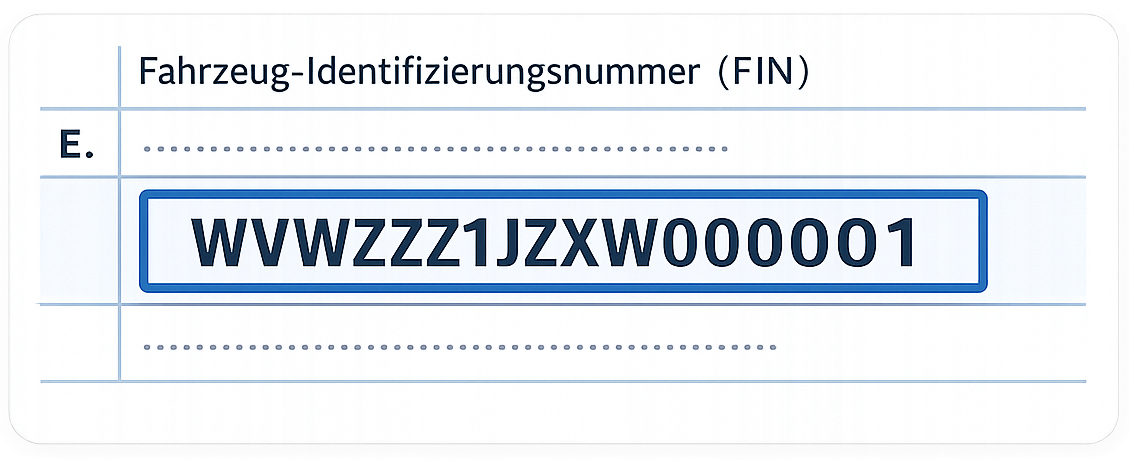
The exact meaning of individual characters may vary depending on the manufacturer, vehicle type and market.
Where can the VIN be found?
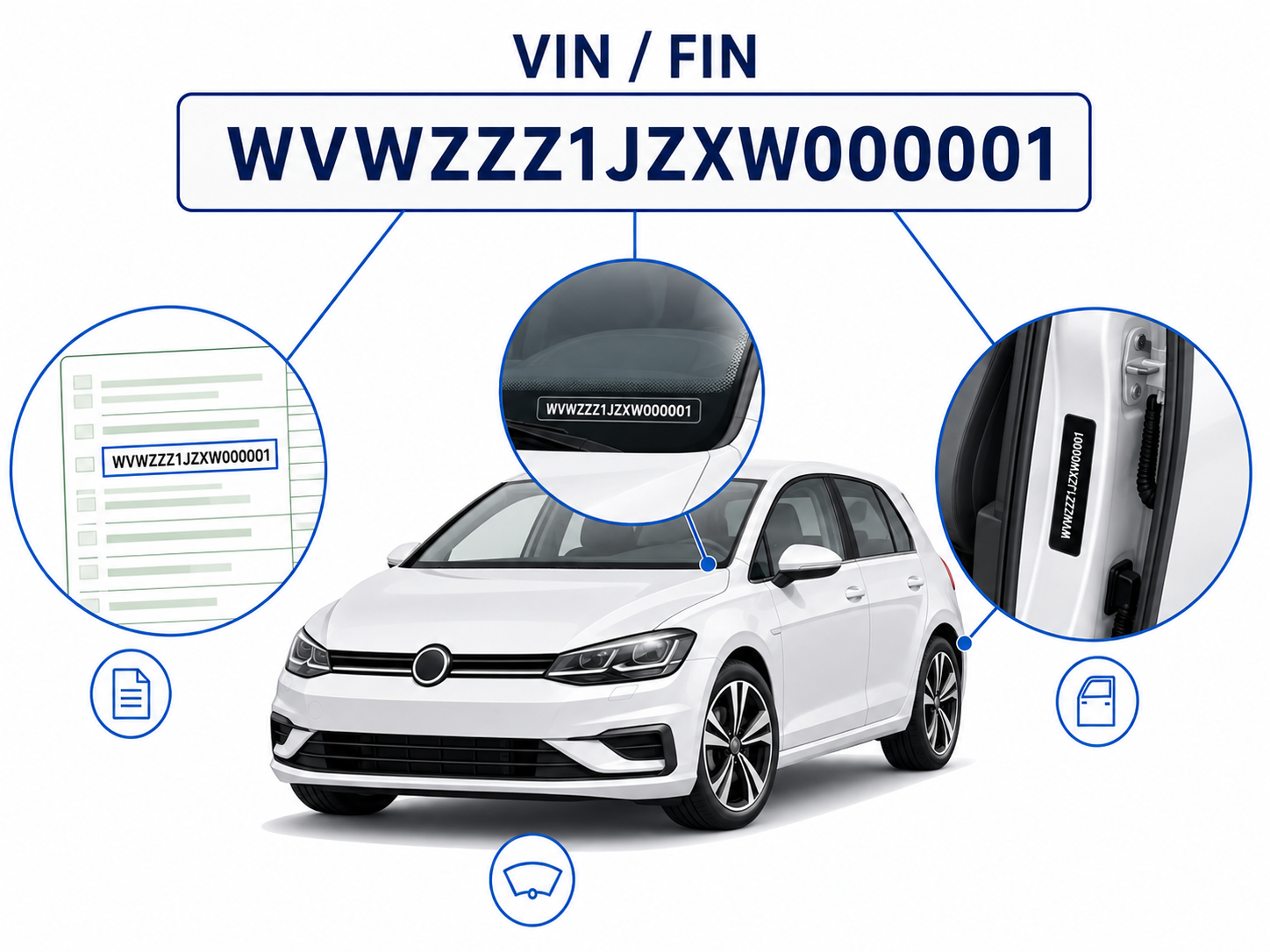
The Vehicle Identification Number can usually be found:
- in the vehicle registration documents
- on the vehicle identification plate
- on the body or chassis
- near or behind the windscreen
- in the engine compartment or on the door pillar
Its exact location depends on the vehicle manufacturer and model.
What is the VIN used for?
The VIN or FIN is used for purposes such as:
- vehicle registration and insurance
- unique vehicle identification
- maintenance and repairs
- vehicle recalls
- spare parts searches
- vehicle history checks
- assignment of technical vehicle data
In the automotive aftermarket, the VIN helps identify a vehicle accurately and find suitable replacement parts.
What is a VIN decoder?
A VIN decoder analyses the characters in a Vehicle Identification Number and matches them with known manufacturer and vehicle data.
Depending on the available database, a VIN decoder may provide information such as the manufacturer, model, engine, model year or production plant.
However, not every vehicle detail can be determined from the VIN alone. Some information must also be retrieved from manufacturer or vehicle databases.
What role does the VIN play in an automotive PIM?
In an automotive PIM system, VIN-based vehicle data can be linked with product information and vehicle applications.
This makes it possible to assign replacement parts more accurately to specific vehicles and provide them through catalogues, online shops or workshop applications.
Conclusion
VIN and FIN refer to the unique identification number of a vehicle. VIN is the internationally used term, while FIN is mainly used in German-speaking countries.
The usually 17-character identifier contains manufacturer and vehicle information and plays an important role in vehicle registration, maintenance, identification and spare parts searches.