What is an OEM (Original Equipment Manufacturer)?
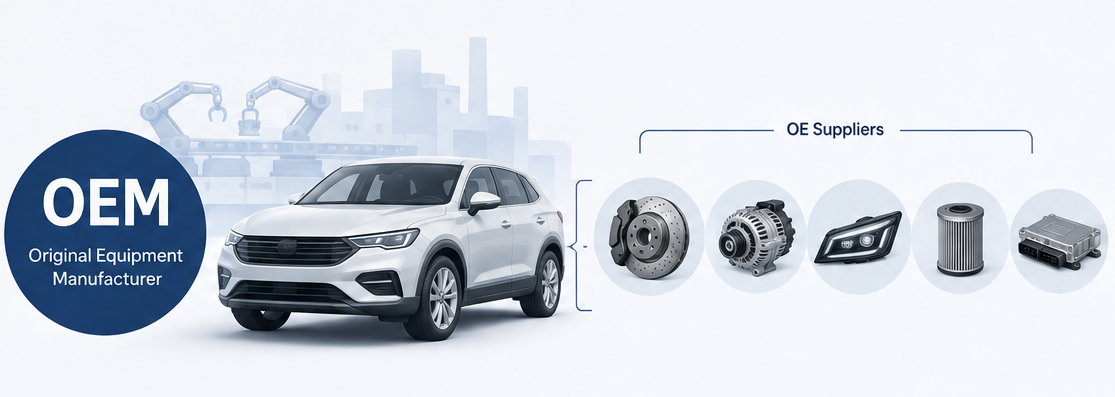
OEM stands for Original Equipment Manufacturer. In the automotive industry, the term usually refers to the manufacturer of a complete vehicle.
An OEM develops or produces an end product that is sold under its own name or brand. The components required for this product may be manufactured by the OEM itself or sourced from specialised suppliers.
Automotive OEMs define the technical requirements for their vehicles, integrate the individual components and bring the finished vehicles to market.
What does OEM mean in the automotive industry?
An automotive OEM is responsible for the development, production and marketing of vehicles. These may include:
- passenger cars and commercial vehicles
- motorcycles
- buses
- agricultural vehicles
- construction and special-purpose vehicles
The OEM defines the technical specifications for the vehicle and its components. However, many components are developed and manufactured by specialised suppliers.
Typical components include:
- engine and transmission parts
- brake and chassis components
- electrical and electronic systems
- lighting systems
- filters
- sensors
- interior components
- body and exterior parts
The vehicle manufacturer tests the supplied components, integrates them into the vehicle and markets them as part of the finished product.
What is the difference between an OEM and an OE supplier?
The terms OEM and OE supplier are often confused.
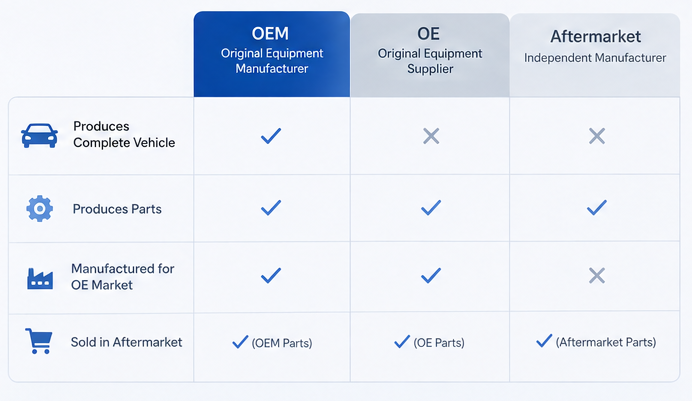
In the automotive industry, the OEM is generally the manufacturer of the complete vehicle.
An OE supplier, on the other hand, produces components or systems for the original equipment of a vehicle. OE stands for Original Equipment.
For example, a supplier may develop and manufacture a braking system, headlight or sensor according to the vehicle manufacturer’s specifications. The component is then used in vehicle production.
The supplier is therefore part of the original equipment supply chain but is not automatically a vehicle OEM.
What are OEM parts?
The term OEM parts is often used for replacement parts sold by or under the brand of the vehicle manufacturer.
These parts meet the vehicle manufacturer’s specifications and are distributed through its sales and service network. They may be produced by the OEM itself or by an authorised OE supplier.
The terms OEM part, original part and OE part may be used differently depending on the market and supplier. It is therefore important to check:
- who manufactured the component
- under which brand it is sold
- whether it was produced for original equipment
- whether it meets the vehicle manufacturer’s specifications
- through which distribution channel it is offered
What is the difference between OEM, OE and aftermarket parts?
Several different terms are used in the automotive replacement parts market.
OEM parts
OEM parts are generally sold under the vehicle manufacturer’s brand. They meet the requirements defined by the OEM and are intended for specific vehicles.
OE parts
OE parts come from a manufacturer that produces components for the original equipment of vehicles. The replacement part may be technically equivalent to the component originally installed in the vehicle but may be sold under the supplier’s own brand.
Aftermarket parts
Aftermarket parts are manufactured for the replacement parts market and sold outside the vehicle manufacturer’s distribution network. They may come from OE suppliers or other replacement parts manufacturers.
Quality, design and price may vary depending on the manufacturer and product.
What role do OEM numbers play in the automotive aftermarket?
Vehicle manufacturers use their own part numbers to identify components. These are commonly referred to as OEM numbers, OE numbers or original part numbers.
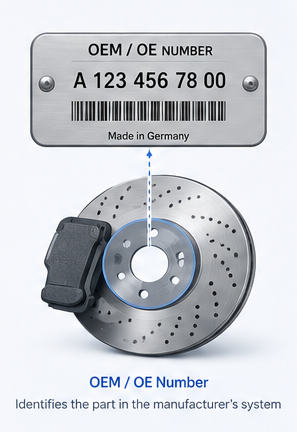
OEM and OE numbers support:
- the unique identification of vehicle parts
- the assignment of replacement parts to vehicles
- the search for suitable alternative products
- the comparison of manufacturer and aftermarket articles
- the prevention of incorrect orders
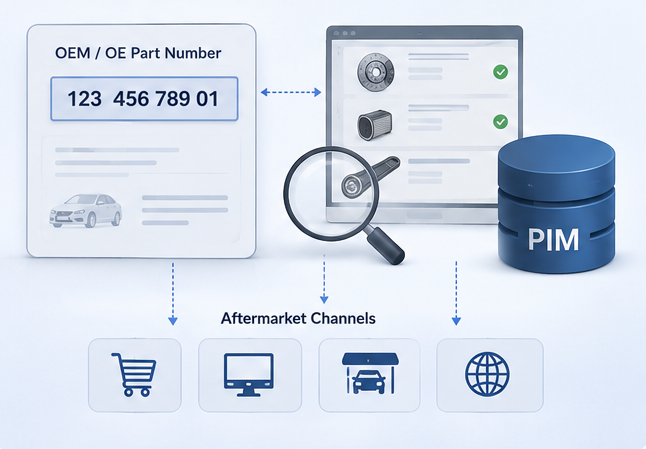
In the automotive aftermarket, these numbers are often linked to product data, vehicle applications and reference numbers.
Systems such as TecDoc provide these relationships in a structured format and make it possible to search for suitable replacement parts using OE references.
For more information, see What is TecDoc?.
What is the importance of OEM data for a PIM system?
A Product Information Management system (PIM) centrally manages product information and provides it to different sales and distribution channels.
In the automotive aftermarket, OEM-related product data may include:
- OEM and OE numbers
- vehicle manufacturers and models
- technical attributes
- installation positions
- vehicle linkages
- reference and comparison numbers
- product images and documents
- country-specific product information
An automotive PIM helps manufacturers and suppliers structure and validate this information and make it available for catalogues, online shops, marketplaces and data standards such as TecDoc.
Conclusion
OEM stands for Original Equipment Manufacturer. In the automotive industry, the term usually refers to the manufacturer of a complete vehicle.
OEMs develop vehicles, define technical requirements and integrate components produced by specialised suppliers. In the replacement parts market, OEM and OE numbers play an important role in identifying and assigning suitable vehicle parts.
A powerful automotive PIM system helps companies centrally manage OEM references, technical product data and vehicle linkages and provide them across different sales channels.