OE Numbers, OEM and OES
The terms OE number, OEM and OES are often used together in the automotive aftermarket. However, they describe different aspects of original equipment and parts identification.
What is an OE number?
An OE number is a part number used by a vehicle manufacturer for a component, assembly or original replacement part. OE stands for Original Equipment.
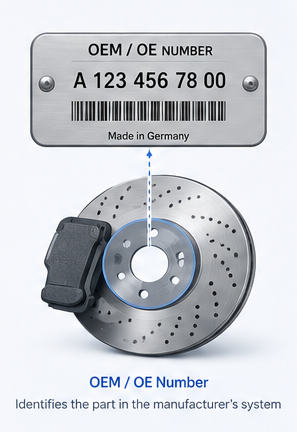
Other commonly used terms include:
- OE part number
- original part number
- OEM number
- OE reference
OE numbers are listed in vehicle manufacturers’ parts catalogues. In the aftermarket, they are used as references to identify suitable or comparable replacement parts.
An OE number is not necessarily unique worldwide. Different vehicle manufacturers may use their own numbers for the same component. Older OE numbers may also be replaced by newer part numbers.
What does OEM mean?
OEM stands for Original Equipment Manufacturer. In the automotive industry, the term usually refers to the manufacturer of the complete vehicle.
The OEM develops the vehicle, defines the technical requirements and assigns OE numbers to the components and replacement parts used.
For a more detailed explanation, see What is an OEM?.
What does OES mean?
In this context, OES stands for Original Equipment Supplier. It refers to a supplier that develops or manufactures components and systems for the original equipment of a vehicle manufacturer.
An OES may supply brakes, sensors, filters or spark plugs according to the OEM’s specifications. These products may be installed during vehicle production or distributed through the vehicle manufacturer’s authorised replacement parts network.
A company is not automatically an OES for its entire product portfolio. The term usually applies to specific components, vehicle programmes or supply relationships.
Note: In some market reports, OES is also used for the authorised original equipment service or replacement parts channel. The intended meaning should therefore be determined from the context.
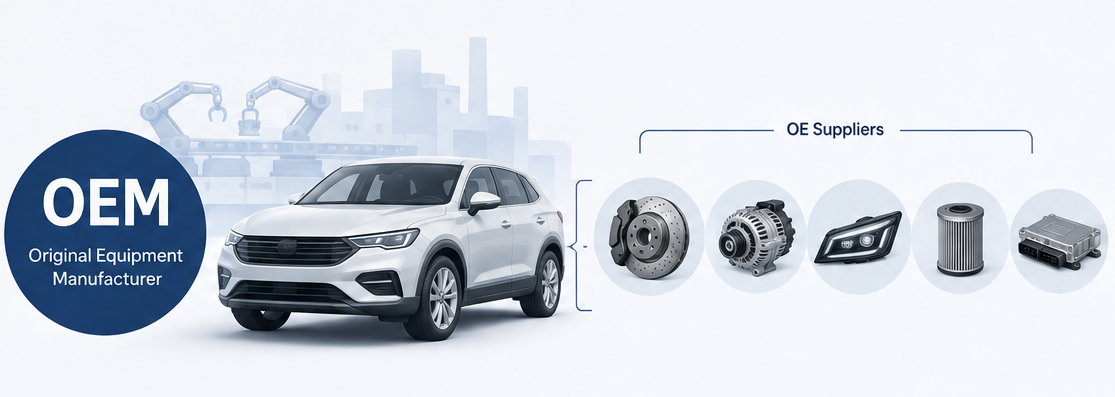
How are OE numbers, OEMs and OESs related?
In simplified terms:
- The OEM defines the vehicle and the requirements for the component.
- The OES develops or manufactures the component for original equipment.
- The OEM lists the component under an OE number in its parts catalogue.
- Aftermarket manufacturers use the OE number as a reference for suitable replacement parts.
Why are OE numbers important for an automotive PIM?
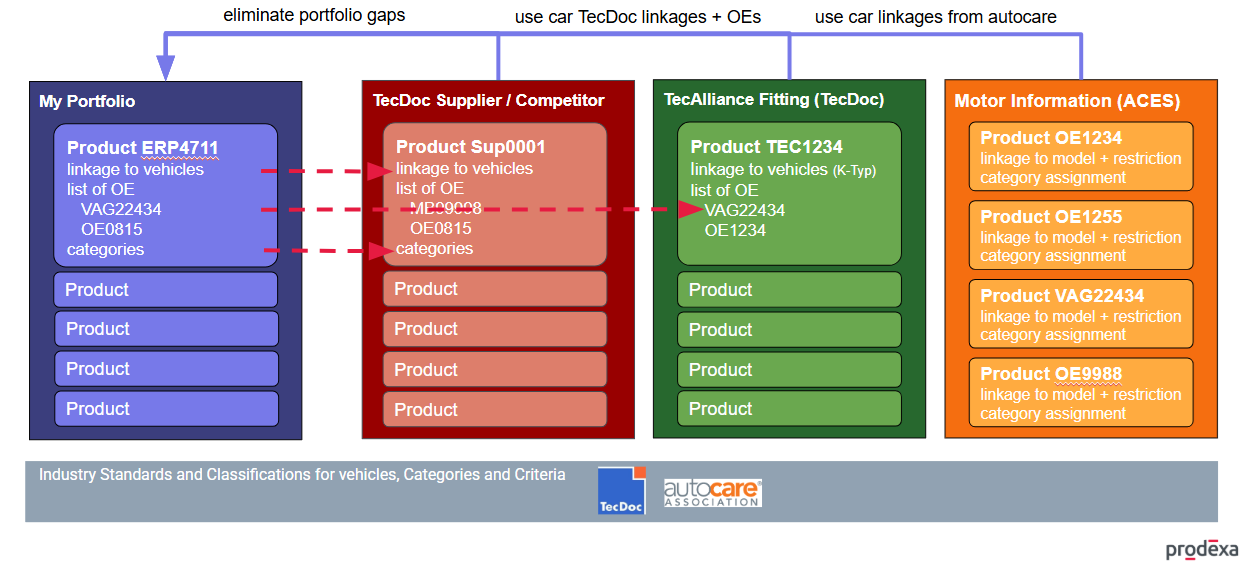
In an automotive PIM system, OE numbers are linked to a company’s own articles, vehicle applications and other reference data.
This helps companies to:
- find suitable aftermarket articles for OE numbers
- identify missing or outdated references
- manage superseded and replacement part numbers
- validate vehicle applications
- provide product data for TecDoc, ACES and digital catalogues
Conclusion
The OEM is the vehicle manufacturer, while the OES supplies components for its original equipment. The OE number is the reference used by the vehicle manufacturer to identify a component or original replacement part.
In the automotive aftermarket, OE numbers provide an important foundation for cross-references, parts identification and vehicle applications.