Linkages, Vehicle Applications, Compatibility and Fitment
Vehicle applications describe which vehicles or vehicle configurations a replacement part is suitable for.
Depending on the market, data standard and system, several related terms are used in the Independent Automotive Aftermarket (IAM):
- linkage or vehicle linkage
- vehicle application or car application
- fitment or fitment data
- vehicle compatibility or part compatibility
- application data
These terms are closely related but do not always have exactly the same meaning.
How do the terms differ?
A vehicle application or car application is the business-level assignment of a product to a defined vehicle or vehicle configuration.
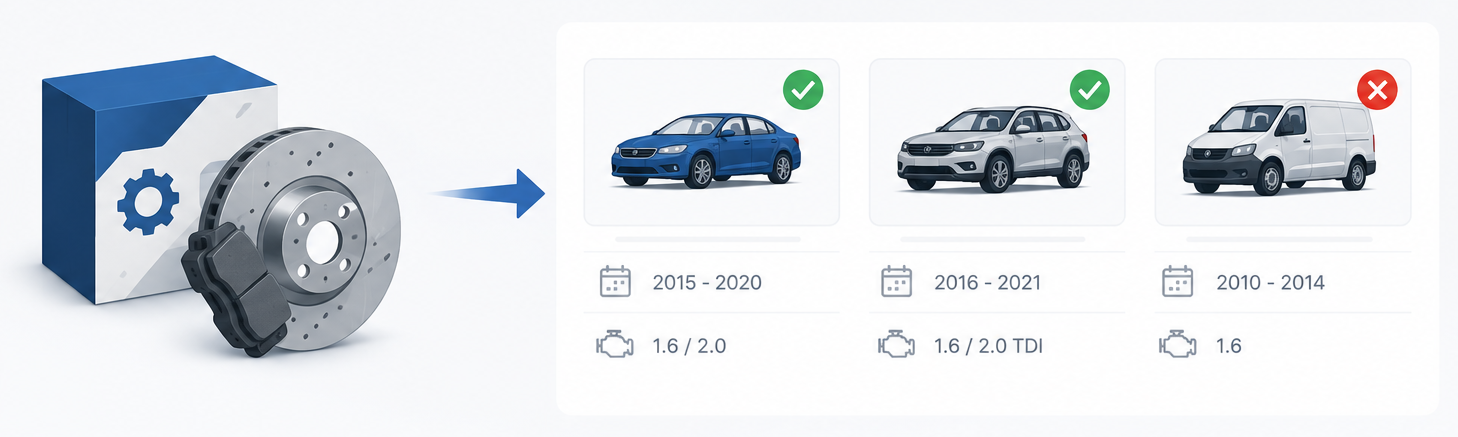
A linkage is the stored relationship between a product and a vehicle record within a data model, catalogue or industry standard.
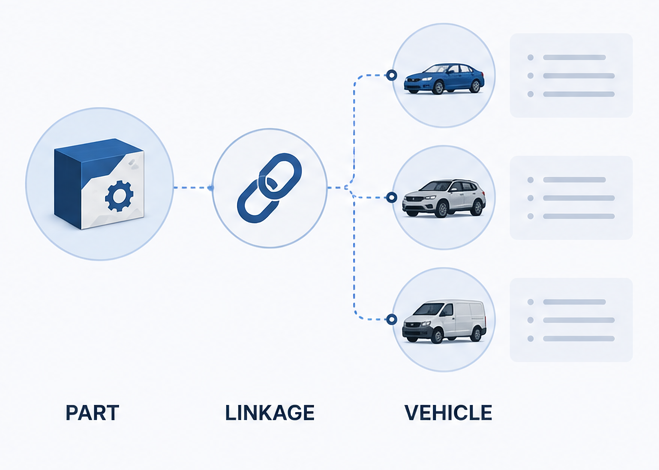
Fitment describes the suitability of a product for a specific vehicle. Fitment data may include the application itself as well as restrictions and additional usage criteria.
Compatibility is a general, customer-friendly term indicating that a part fits a vehicle. It does not necessarily represent a formally defined data object within every industry standard.
What additional information can an application contain?
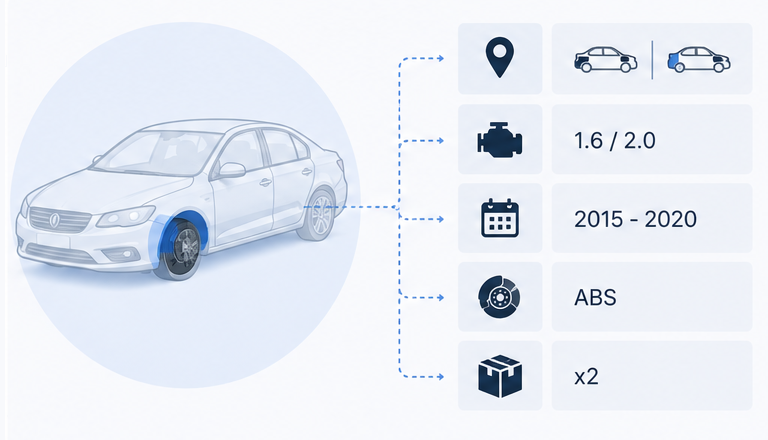
A vehicle application can be supplemented by installation and usage criteria. Depending on the standard, these may be called fitment criteria, qualifiers, linkage criteria or application notes.
Examples include:
- assembly side, such as left, right, front or rear
- engine, body or equipment variant
- model year or production period
- suspension or braking system
- required quantity
- other technical restrictions
Fitting information or installation information therefore supplements an application or linkage but is not a complete synonym for it.
Why are linkages and vehicle applications important?
Accurate application data supports:
- reliable replacement parts identification
- more precise searches in catalogues and online shops
- fewer incorrect orders and returns
- standardised exchange of product and vehicle data
It is therefore one of the most important types of product information in the automotive aftermarket.
What role does an automotive PIM play?
An automotive PIM system centrally manages products, vehicle applications, linkages and additional fitment criteria.
The data can then be supplied to different standards and sales channels, including TecDoc, ACES, replacement parts catalogues, online shops and marketplaces.
Conclusion
Vehicle applications describe the business-level assignment of a replacement part to a vehicle. Linkages represent this relationship within the underlying data model.
Fitment and compatibility describe product suitability, while additional criteria define the specific installation and usage conditions.